A Ten-Minute Debrief After a Shared Project
A ten-minute project debrief helps your group capture a useful practice, choose one change to try, and carry an open question into the next project.
A ten-minute project debrief can help a group capture one useful practice, choose one change to try, and carry an open question into its next project. Put it on the calendar near the work’s natural endpoint, while people can still recall the handoffs, decisions, and small snags that shaped the project.
This is not a verdict on the project or a performance review. It is a short closing conversation that turns shared experience into a few usable notes. Keep the scope narrow: one practice to preserve, one adjustment to try, and one question to carry forward.
When should the group meet?
Schedule the debrief at the project’s natural endpoint: after the final deliverable is handed off, the event is cleared, or the shared task is complete. If the group waits until another project has taken over everyone’s attention, details may blur and the conversation can become a general impression rather than a reflection on actual work.
Choose a time when the people who did the work can attend without rushing straight into another obligation. A small team can use a meeting room or a video call. For a larger group, invite the people whose perspectives are needed to understand the project’s working process, rather than treating the debrief as an audience for announcements.
Send a brief invitation with the three prompts and the purpose of the meeting. Ask participants to arrive with one specific moment in mind for each prompt, though no one needs to prepare a speech. Naming the questions in advance gives quieter thinkers a chance to gather their thoughts without turning the debrief into homework.
What should you prepare before a ten-minute project debrief?
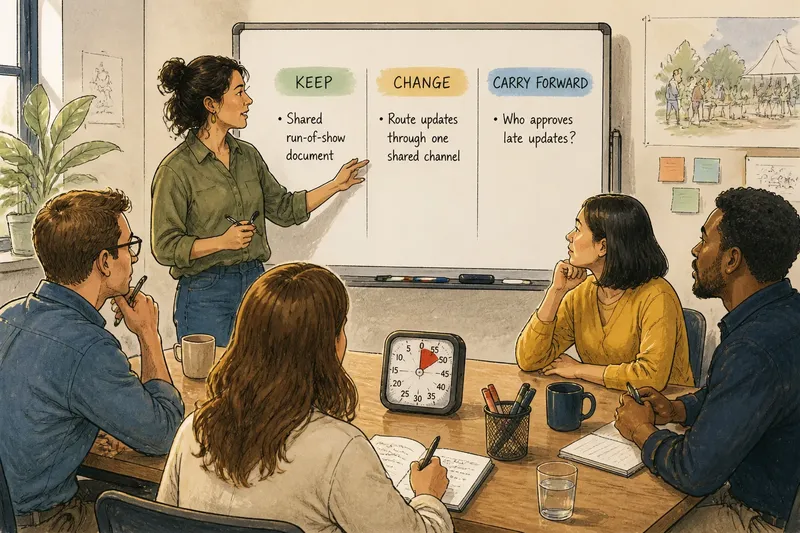
Bring a visible timer and a shared place to capture the group’s wording: a whiteboard, a blank Google Doc, or a sheet of paper. Use three headings—Keep, Change, Carry Forward. The notes should be easy to revisit, but avoid recording personal judgments or assigning blame. Capture useful observations, not every sentence spoken.
One facilitator is enough. Their job is to keep the conversation on the prompts, invite contributions, and notice when the group is drifting into a different meeting. If the facilitator also worked on the project, they can contribute as a participant while being clear that they are not there to settle whose account is correct.
Agree on a simple boundary: discuss actions, conditions, and coordination rather than labeling people. “The draft arrived after the review slot, so we had to compress the check” gives the group something it can examine. “That person is always disorganized” turns a working detail into a personal charge and is unlikely to help the next project.
How can you use the time well?
The schedule below is one suggested format, not a validated duration that will reliably fit every group or project. Treat the minute allocations as flexible prompts, not deadlines. A small group with a clear example may move quickly; a larger group or a point needing clarification may need more time. Adjust the pace to the discussion, and if the conversation cannot responsibly cover all three prompts, record what remains open and arrange a follow-up rather than rushing people to agreement.
- Suggested minutes 0–1: Set the frame. State that the group is looking for one thing to preserve, one thing to change, and one question to carry forward. Remind everyone that the aim is learning from the work, not scoring it.
- Suggested minutes 1–3: Name what to keep. Ask, “What helped us work well that we should carry into the next project?” Invite brief contributions. Choose a practice or condition the group can describe concretely.
- Suggested minutes 3–5: Name what to change. Ask, “What is one adjustment that could make the next project work better?” Keep suggestions within the group’s influence where possible. Record an action or trial rather than a vague wish such as “communicate more.”
- Suggested minutes 5–7: Name the question to carry forward. Ask, “What do we still need to understand before we can work differently?” The question might concern an unclear handoff, an assumption about who approves a draft, or a tool that did not fit the task. Leave it open if the group cannot answer it responsibly in this conversation.
- Suggested minutes 7–9: Make the notes usable. Read the entries aloud. Clarify any phrase that could mean different things to different people, and identify who will keep the notes or bring the open question into the next planning conversation.
- Suggested minutes 9–10: Close the loop. Ask whether the notes fairly reflect the conversation, then state where they will live and when the group will look at them again. If the discussion needs more time, agree on a follow-up instead of squeezing a new topic into the close.
The point is not to fit every thought into a clock. It is to leave with a short record that distinguishes a practice worth repeating from a change worth trying and a question that remains unresolved. If the group needs more than the suggested format allows, the notes can preserve that decision too.
How do you keep the three prompts distinct?
The prompts can blur together unless the facilitator helps the group name what each one is for. “Keep” is about a practice or condition that served the work. “Change” points to an adjustment the group can attempt. “Carry Forward” preserves uncertainty that needs attention rather than pretending the debrief has settled it.
Imagine a community workshop has just ended. The group’s starting notes say that volunteers used a shared run-of-show document, late speaker updates arrived through several channels, and no one is sure who approves those updates. The facilitator records the document under Keep, agrees to try routing updates through one shared channel under Change, and writes “Who approves late updates?” under Carry Forward. The observable result is three distinct notes: a practice to repeat, an action to try, and an unanswered question—not a claim that the new channel will solve every coordination problem.
If several people offer the same kind of observation, combine them into one clear note rather than expanding the debrief into a list of every success and irritation. When comments point in different directions, capture the difference briefly and choose a question to investigate later. A short conversation does not have to resolve every disagreement to be useful.
What if the conversation gets stuck?
A pause can mean people are thinking, not that the group has nothing to say. Give the room a moment before rephrasing the prompt. If it still feels hard to answer, ask about a particular handoff, decision, or moment when the work slowed down; a concrete cue is often easier to discuss than a broad request to evaluate the whole project.
If someone moves into blame, bring the conversation back to what happened and what the group could learn from it. If the subject raises a serious concern that needs a private or formal process, do not try to settle it in a brief group reflection. Acknowledge that it needs a separate conversation and use the appropriate support for the situation.
When the group starts generating a long list of possible improvements, ask which single change is most useful to consider next. When a discussion becomes a debate over whose memory is accurate, distinguish what the group knows from what it still needs to find out. That unresolved point may be the best question to carry forward.
What questions help a short debrief work?
Who should attend a project debrief?
Invite the people who took part in the work and can speak to how it unfolded. If a key perspective is missing, note that limitation and seek it separately rather than asking present participants to guess what an absent person experienced.
Should everyone speak during a ten-minute debrief?
Offer each person a chance to contribute, but do not require a long response or force someone to share. A brief written note before discussion can help people who need a moment to organize their thoughts.
What if the group cannot agree on what to change?
Record the different views in concise, neutral language and identify what information would help the group decide later. If it is reasonable, consider a small, reversible adjustment rather than treating it as a final resolution.
Where should the debrief notes go?
Save them somewhere the project group already uses, such as its shared drive or team workspace, with a clear title that connects them to the project. Keep the notes brief enough that someone can find the three entries without reading a transcript.
How should the group use the notes later?
At the next project kickoff or planning conversation, bring back the three entries. Check whether the group kept the useful practice, whether it tried the proposed adjustment, and whether the open question has gained an answer. This should be a quick return to the record, not a second debrief disguised as a status meeting.
If the proposed change was not tried, ask what got in the way before proposing it again. If the carried question no longer matters, close it. If it still matters, name the next person or conversation that can help answer it. The notes have done their job when they shape a later choice, not merely when they have been saved.
Keep the open question visible after the room empties by adding it to the next agenda or attaching it to the relevant planning note. That small handoff keeps reflection connected to the work ahead and helps the group decide whether the question still deserves attention.