Choosing Between a Show of Hands and a Written Ballot
Compare a show of hands with a written ballot to choose a group voting method that fits the stakes, privacy needs, and record your decision requires.
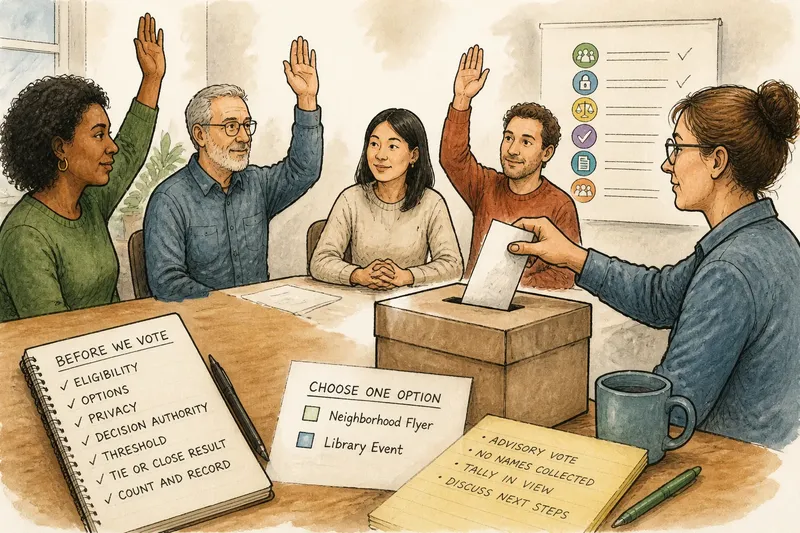
For a quick, low-stakes choice, a show of hands is often enough; when people need privacy, a written ballot is usually the better fit. Choosing between a show of hands and a written ballot depends on what the group needs to learn and how safe members feel expressing a preference.
What does a show of hands tell the group?
A show of hands gives an immediate, visible count. Participants can see whether support appears broad or divided, and a facilitator can move straight to the next part of the conversation. It can work well for choosing which agenda item to discuss first when members are comfortable disagreeing in public.
That visibility is also a limitation. People may follow a manager, a senior member, or the first person to raise a hand. The vote can reflect the room’s social pressure as well as individual preferences, so it is a poor fit when participants could feel exposed or penalized for their choice.
What does a written ballot change?
A written ballot lets each person record a choice without announcing it to the group. Paper slips, a form, or a private poll can be useful when members need space to decide independently. The facilitator should say whether the ballot is anonymous, who will see responses, how the count will be reported, and whether the result is advisory or binding.
Privacy does not explain why people chose an option or whether they support the decision with confidence. A tally may show a split, but discussion may still be needed to understand the concerns behind it. A ballot also requires a clear process for collecting and counting responses.
How should a group choose a voting method?
Match the method to the decision, the relationships in the room, and the record the group needs. A visible vote can suit a modest, reversible choice among peers who can disagree openly. A private ballot can be preferable when rank or sensitivity could shape public responses. For a governed organization, follow its rules and consult a qualified professional when the applicable requirements are unclear.
Imagine a volunteer committee choosing between a neighborhood flyer and a library event while its chair favors the flyer. The facilitator wants an initial preference, not a binding decision. Before anyone votes, the facilitator confirms that every committee member may respond, marks the two options on identical slips, and tells the group that no names will be collected. Members submit one slip each; the facilitator counts the choices in view and reports the totals without identifying voters. The result gives the committee a private preference count, but it does not settle the decision: members can discuss the event’s advantages and decide whether they have enough information to proceed.
Before collecting responses, agree on eligibility, options, the decision threshold, and what happens in a tie. If the group may need to revisit the choice, say how and when that discussion will happen. Settling these points first keeps a disagreement about procedure from clouding the discussion about the actual options.
What should the group check before voting?
- Eligibility: Check who has authority to vote; if the group’s rules identify eligible voters, use that list, and if they do not, pause to agree on eligibility before collecting responses.
- Option wording: Check that every option is distinct and understandable; if members interpret an option differently, clarify or revise it, and if they understand it alike, proceed with the agreed wording.
- Privacy: Check whether names or individual choices will be visible; if exposure could affect responses, choose an anonymous ballot, and if public accountability is needed, use a visible vote and explain the record.
- Decision authority: Check whether the vote is advisory or binding; if the group lacks authority to make the final choice, record the result as advice and refer it to the proper decision-maker, and if it has authority, state that clearly before voting.
- Threshold: Check what result counts as approval; if the group has governing rules, apply them, and if no threshold is set, agree on one before the vote rather than interpreting the count afterward.
- Tie or close result: Check what happens if support is evenly divided or unclear; if no procedure exists, pause for discussion or defer the decision, and if a tie-break rule exists, explain and apply it.
- Count and record: Check who will count responses and what the group needs to retain; if the count needs verification, have another participant check it, and if no lasting record is required, share the result without keeping unnecessary personal details.
Which questions help settle the method?
Is a show of hands anonymous?
No. People in the room can see who raises a hand, even if the facilitator does not keep a written record. Use a private method when the choice itself should not be visible to other participants.
Does a written ballot create consensus?
No. It records selections, but it does not show whether members understand or support the reasoning behind the outcome. If the group needs shared understanding, discuss the concerns before treating the result as settled.
When should a group pause before voting?
Pause if members do not understand the options, lack the authority to decide, or need more discussion about consequences. Check the group’s rules before proceeding if they prescribe a particular process.
Can a group change its voting method?
Yes, if members agree to the change before responses are collected and it complies with the group’s rules. Changing methods after seeing an early result can undermine trust, so settle the process in advance.
A show of hands makes support visible; a written ballot limits who can see each person’s choice. For choosing between a show of hands and a written ballot, make the purpose, privacy, and meaning of the result explicit before anyone responds. If the count leaves an important concern unresolved, treat that as a reason for another conversation—not as a flaw the voting method can hide.