Why a Shared Aim Changes the Shape of a Meeting
A shared aim for a meeting helps a group sort agenda items, protect discussion time, and decide what can wait without losing sight of the work.
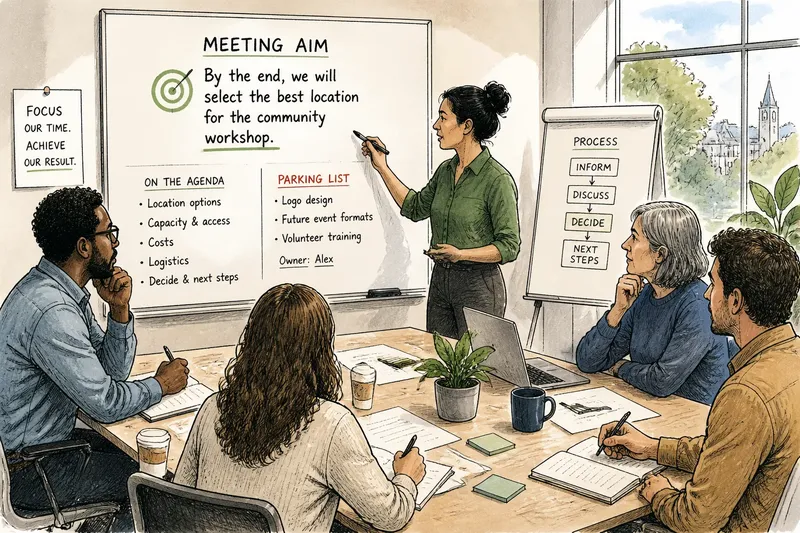
A shared aim for a meeting gives people a practical way to decide what belongs on the agenda and what can wait. Without one, a team may spend its hour discussing every topic that feels important; with one, members can ask whether each item helps produce the meeting’s intended result.
The aim is not a slogan such as “get aligned” or “talk about the launch.” It names the work the group needs to complete together. That distinction matters most when requests arrive late, discussion wanders, or participants disagree about what the meeting is for.
Why does the agenda keep growing?
An agenda often expands because people are using it to collect concerns rather than to organize a particular piece of work. A request about a delayed handoff, a staffing worry, and a question about next month’s event may all be legitimate. But legitimacy alone does not make each topic useful in the same meeting.
Try writing the meeting’s purpose as an observable outcome before adding agenda items. “Decide which two outreach channels the team will use for the next event” gives the group a boundary. “Discuss outreach” does not: it could invite brainstorming, a status report, a budget conversation, or all three.
Then check each proposed item against that outcome. Keep items that provide information the group needs, surface a choice it must make, or help it reach the stated result. Move unrelated subjects to a separate meeting, an asynchronous update, or a parking list with an owner who can bring them back at an appropriate time.
Say you are convening a planning group to choose the location for a community workshop. Someone adds a discussion of the group’s logo. If the aim is to select a location, the logo can wait; the group can record it for a later design conversation instead of letting it compete with the location decision.
Why do people arrive with different expectations?
People may hear the same meeting title and imagine different tasks. “Project planning” could mean sharing updates to one person, generating options to another, and approving a schedule to someone else. When expectations stay unspoken, participants can feel that the meeting has changed direction even if the organizer thinks it is proceeding normally.
State the aim in the invitation and repeat it at the start. Include the decision or deliverable, not just the subject area. For example: “By the end, we will agree on the order of the three remaining tasks and assign an owner to each.” That tells people what kind of preparation may help and what they are being asked to accomplish.
If the group cannot name one outcome, the meeting may be trying to serve several different purposes. Separate a briefing from a decision session when possible. A briefing gives people information; a decision session uses shared time to compare options and reach a choice. Combining them without saying so can leave people unsure whether they should listen, question, propose, or decide.
For a recurring meeting, revisit its purpose rather than assuming the old one still fits. A team that once needed to coordinate daily work may now need time to resolve cross-team dependencies. The calendar slot can stay the same while the shared aim changes.
Why does the conversation drift away from the topic?
Drift can begin when an agenda item has no clear connection to a result. It can also happen when a useful point opens a nearby but separate question. A discussion about choosing a workshop location, for instance, might turn into a debate about the format of every future event. The connection is understandable, but the larger topic can consume the time reserved for the immediate choice.
When the conversation wanders, return to the aim without treating the detour as a failure. Ask, “Does this help us select the location today, or should we capture it for another conversation?” The question makes the boundary visible and gives the group a fair way to decide whether to continue.
Keep a visible parking list on a shared document or whiteboard. For each deferred item, note what needs attention and who will decide where it goes next. A parking list should not become a quiet way to discard concerns; it gives them a place while protecting the work the group came to do.
If a side topic turns out to be necessary for the stated outcome, adjust the agenda openly. The group might agree to spend time clarifying a constraint before comparing locations. Say what will be shortened or moved so participants understand the trade-off.
Why does the group finish without a clear result?
A meeting can have lively discussion and still end without an outcome if its purpose was phrased as an activity rather than a destination. “Review the options” describes something people can do for the whole hour without making a choice. “Select a preferred option or identify the information still needed to choose” gives the discussion a useful stopping point.
Before the meeting, decide what counts as a completed result. It might be an agreed choice, a recommendation for someone else to approve, a list of unresolved questions, or a named next action. These are different outcomes, so use wording that matches the group’s authority and the work at hand.
During the conversation, check whether the group has reached that point. If it has, state the result plainly and confirm who will record or carry out any follow-up. If it has not, name what remains unresolved and choose a next move: continue if time and purpose allow, assign a follow-up, or schedule a separate conversation.
This avoids the familiar closing exchange in which people say they feel “mostly aligned” but leave with different interpretations. A concrete outcome lets participants check whether they are leaving with the same understanding, without forcing consensus where the group has not reached it.
How can a shared aim help with common meeting problems?
What should I write as a meeting purpose?
Write the result the group should produce, using a clear action such as choose, agree, prioritize, or identify. Add the subject and any meaningful boundary, such as which options are under consideration or what must be settled today.
What if several outcomes seem equally important?
Choose the outcome that requires people to work together at the same time, then move information-sharing or separate decisions elsewhere when practical. If the outcomes genuinely depend on each other, state that relationship and give each one a place in the agenda.
What if a participant brings up something urgent but off-topic?
Ask whether it changes the group’s ability to complete the stated purpose. If it does, make the connection explicit and decide together whether to adjust the agenda; if it does not, record who will route the concern to the right person or conversation.
Does every meeting need a final decision?
No. A meeting may be intended to clarify a problem, develop options, or identify what information is missing. State that outcome directly so participants do not mistake a working conversation for a decision session.
How do you make the aim useful before people arrive?
Draft the aim before building the agenda, then use it to shape the invitation, preparation request, and time available. If a participant needs to bring a document or consider a choice, say what kind of contribution is relevant. Avoid asking everyone to prepare broadly for a topic that the group has not defined.
Give agenda items a clear job. A brief update may supply context; a comparison may help the group assess options; a discussion may surface constraints; a closing item may confirm the result and responsibilities. Naming the job helps people see why an item is present and what it contributes to the shared aim.
At the meeting, keep the purpose where participants can see it. A line at the top of a shared agenda is often enough. When a proposed topic competes for time, the group can compare it with that line rather than relying on the facilitator’s private judgment.
Afterward, the shared aim can also make the record more useful. Capture the outcome in terms that match the purpose, along with any unresolved question and the person responsible for its next step. If the meeting did not reach its intended result, note what prevented it and whether the aim, preparation, or agenda needs to change next time.
A shared aim for a meeting does not make every discussion easy, but it gives the group a common reference point when the agenda gets crowded or the conversation shifts. Write one concrete result, use it to sort what belongs, and let the remaining topics wait with a clear next place to go.